

SD-WAN Explained
SD-WAN Explained
In the modern day, business is no longer confined to one specific geographic area, especially with the rise in popularity of remote employees and hybrid work schedules. Traditional methods of conveying information across networks are no longer the best option due to security threats and the prevalence of cloud-based applications, and that’s where SD-WAN comes in.
What does SD-WAN stand for, and why do you need it? In this article, the expert telecom consultants at Vatic Outsourcing walk you through this important aspect of digital transformation, and how we can help you find the best SD-WAN configuration for your business.
SD-WAN Definition
SD-WAN stands for “software-defined wide area network,” but to understand SD-WAN, you should first understand what a WAN, or wide area network, is. A traditional WAN uses hardware network devices, typically Multi Protocol Label Switching (or MPLS), in order to allow network traffic to flow efficiently. It may connect many Local Area Networks (LANs) and Virtual Private Networks (VPNs) to a hub or data center.
As the name implies, SD-WAN is simply a software-defined approach to managing a WAN. It can connect several office locations to one central location because it is not dependent on hardware. It uses software-defined networking to find the most effective way to route traffic, even to remote locations. As SD-WAN is a virtual WAN architecture, enterprises that deploy it can utilize different transport services including MPLS, LTE, fiber networks, satellite, and broadband internet.
SD-WAN is a cloud-first way to build a WAN, and more efficiently connects users to their applications, allowing them to access those applications from any device, anytime, and from anywhere.
How does SD-WAN work? Traditional WANs send traffic back to a central data center, where security inspection services are often administered, and delays occur that can impair application performance. With SD-WAN, the network still has an endpoint hardware, but also has a software overlay that contains connection, security, and network information. An SD-WAN is able to support cloud and SaaS services, which is imperative for modern-day businesses with multiple campuses or remote workers that use cloud-based applications for business initiatives.
What is SD-WAN architecture?
Let’s dig deeper into what makes SD-WAN infrastructure different from traditional WAN and MPLS.
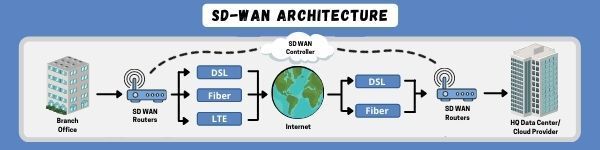
An SD-WAN is typically able to manage multiple WAN connections at once with a centralized controller. As we’ve explained, both have a physical connection, but the SD-WAN also employs a virtual connection that is abstracted from any hardware. This makes it so that the connection can be moved easily from one device to another, or the connection can be altered quickly, depending on changes to the business environment and business needs.
SD-WAN technology eliminates the need for constant, hands-on programming, and also does a much better job of managing and reallocating traffic, particularly when applications begin to demand more bandwidth.
But what does SD-WAN architecture actually look like? Think of this virtualized network as being made of three main components. First is the SD-WAN edge. This can be a remote data center, a cloud, or a physical branch office, but is where the endpoints of the network are located. Next is the SD-WAN orchestrator: this “virtual manager” is the part of the network that is responsible for overseeing traffic and applying any protocol that has been set by the network operators. Finally there is the SD-WAN controller, which centralizes management of the network. The most commonly-used type of SD-WAN architecture is cloud-enabled SD-WANs, which are used to give organizations a backup connection and allow traffic to quickly move between public internet connections and private connections.
What are the benefits of SD-WAN?
The biggest benefits of SD-WAN are that enterprises can deploy their wide-area networks much faster, and reduce costs when doing so. As a virtual network overlay, SD-WAN is being embraced by businesses left and right, producing a billion-dollar market for these services.
Here are some of the key benefits of SD-WAN over MPLS on its own:
SD-WAN Improves Business Productivity
Time is money in the business world, and when businesses rely on applications and consistent connectivity, secure, fast networks are a must. SD-WAN is designed to work seamlessly with the cloud, unlike traditional WAN, which was based on conventional routers. This means that with SD-WAN, there is less delay and better performance of applications, allowing for more productivity and higher customer satisfaction.
SD-WAN Lowers Costs
Traditional WAN can be costly to maintain and update, as constantly upgrading bandwidth takes a lot of time and money. With SD-WAN, it’s as easy to increase bandwidth and install connections as it is to set up a home-based WiFi network. That’s because SD-WAN is composed of a combination of services, including less-expensive internet services.
SD-WAN Improves Security Monitoring
Both SD-WAN and traditional WAN require security add-ons in order to keep information safe. This includes VPNs and IPsec tunnels to ensure traffic isn’t interfered with. If these additional security measures are not made, the unsecured internet connection could allow for data breaches and hacks.
SD-WAN security is much easier to monitor than traditional WAN security because the network is “more visible,” i.e., the network administrators are able to more effectively manage the network in a centralized way, and identify any inconsistencies and network problems. The move to SD-WAN can expose your business to security risks due to its reliance on internet access, so it’s important to consider this as you make the transition.
SD-WAN Promotes Better Disaster Recovery
Because SD-WAN is a virtual network, it allows for more carrier diversity that can help a business bounce back quickly when disaster strikes. A WAN is solely hardware-based, and when attacked by hackers or crippled by other extenuating circumstances, it is much more difficult and time-consuming to bring back online.
Is SD-WAN worth it?
Businesses that make the switch to a Software-Defined WAN find that many of their problems are solved instantly, and any future issues are resolved more efficiently and quickly once the network has been deployed.
If your business has any of these difficulties, you may find that installing SD-WAN infrastructure would be an ideal solution:
- You use cloud-based applications to store business-critical data
- You need a more cost-effective solution to ever-increasing bandwidth requirements
- You don’t want to sacrifice security, but need more optimized application performance
- Your business applications perform slowly
- You consistently suffer from dropped Voice over IP calls
At its core, SD-WAN should support multiple connection types (MPLS, Internet, LTE, Etc.), allow for load-sharing across WAN connections, provide a simple interface for managing WAN, and support VPNS as well as other third-party services. Most business owners find that SD-WAN is worth the investment simply because it allows for better application performance and saves on costs, both of which improve business productivity and accelerate business initiatives.
Choosing an SD-WAN Vendor
Businesses that choose to adopt SD-WAN know that they are preparing their organizations for future growth and expansion, capitalizing on the flexibility and ease of this virtual network architecture to centralize management of all connections and traffic.
In order to take full advantage of the benefits of SD-WAN, companies need to be vigilant about the provider they select. Don’t fall into the trap of wanting to work only with the best SD-WAN vendors; instead, search for the vendor that most aligns with your company’s needs and goals for the future.
An SD-WAN provider that is worth their salt will perform a needs assessment to determine both the quality and bandwidth of the current network, and how an SD-WAN can help a company get the most out of their network. SD-WAN is not a fix-all for poor connectivity, however, so an SD-WAN company may suggest fixes and upgrades prior to the deployment of the new software-driven system. Just make sure they’re not pushing a broadband-only solution when you know your needs are more diverse.
SD-WAN Vendor Selection Criteria
Pricing and performance are the two biggest considerations when choosing an SD-WAN vendor. Vendors who understand the important connection between network application performance and user productivity will not only recommend any necessary upgrades to network bandwidth, but also for optimizing specific services to maximize application performance.
While the cost of maintaining an SD-WAN will be much lower compared to traditional WAN due to a reduction in capital and operational expenses, there is a price for SD-WAN solutions, and it can vary greatly from one vendor to another. Make sure you research your options thoroughly when considering the best match for your company or organization.
Other criteria to look for when moving to an SD-WAN provider include:
- Can the vendor provide full visibility into all areas of the network?
- Does the vendor prioritize network security with central management and maximum protection?
- Will the vendor be able to accommodate and add new capabilities as technology evolves?
- Does the vendor provide a central, administrative console for traffic control, network adjustments, and policy changes?
- Does the vendor assess current needs and project bandwidth capacity for companies they work with?
- Does the vendor provide SD-WAN solutions for the specific needs of the client, whether that be on-premises or cloud-based?
Making sure you do your due diligence to research vendors and understand what they do and don’t provide will increase your company’s chances of leveraging the complete benefits of SD-WAN deployment, giving your business the boost it needs to stay competitive in today’s market.
Moving to an SD-WAN
There is a common assumption that moving to an SD-WAN means abandoning MPLS altogether, but this doesn’t have to be the case. MPLS is so entrenched in corporations that it is not being displaced at companies that migrate to SD-WAN. Rather, SD-WAN starts as an addition to help increase the existing network’s ability to handle bandwidth-heavy applications efficiently. It can also be used to slowly transition companies away from MPLS networks to SD-WAN over time.
When your company has made the decision to move to an SD-WAN, there are a few things you need to iron out first before diving into vendor selection and managed services.
First, considering the applications your company uses or plans to use should be at the forefront of the decision-making process. Look at the applications you currently use, and what you want to implement, in order to determine what your network needs to do and how it needs to be able to grow. Your SD-WAN should be able to support these applications as well as cover security concerns and geographical limitations for the best possible service.
Second, ensure you understand the terms and conditions of your current MPLS contract before you make a decision to terminate the contract prematurely. As we’ve stated, the two can work in tandem, giving you some breathing room until the MPLS contract expires or you are allowed to give notice of termination. You can also employ a hybrid system where you maintain the MPLS service provider contract as well as SD-WAN.
And finally, it may be beneficial to look into assistance with the decision-making process from someone who understands the pros and cons of switching to SD-WAN. While the benefits can’t be denied, there are ways to make the transition process seamless and functional for your business so that no productivity is lost or security compromised. Hiring an outside advisor who can give insight into the various vendors and services out there can help your IT team start this digital transformation task with confidence.
Managed SD-WAN Services with Vatic Telecom Consultants
SD-WAN is an important step for companies looking to improve their networking infrastructure. By choosing the right SD-WAN provider and properly configuring the system, your company can experience:
- Improved performance
- Faster application deployment
- Greater bandwidth capacity
- Increased reliability
SD-WAN is not a one-size-fits-all solution, so it’s important to partner with a telecom consulting provider who understands the various SD-WAN applications and can help you make the best decision for your company. At Vatic Outsourcing, we pride ourselves on our ability to provide tailored SD-WAN consulting that gives our clients a competitive edge in today’s market. SD-WAN is a broad term that can be difficult to understand for those not familiar with the technology. In a nutshell, SD-WAN is a networking solution that uses software-defined networking principles to manage and optimize WAN traffic. SD-WAN replaces legacy routers and firewalls with virtual appliances that can be controlled from a central location, making it easier to manage and deploy applications across multiple locations. By using SD-WAN, businesses can enjoy the benefits of SDN-style networking without having to overhaul their entire infrastructure.
Frequently Asked Questions about SD-WAN (Software-Defined Wide Area Network)

About the Author: Shawn Purcell
CIO/CMO/CPO
As a founding partner, and member of the executive team at Vatic Outsourcing, Shawn Purcell initiated and continues to manage strategic relationships in telecom expense management (TEM) and mobile device management (MDM). He heads up the day-to-day management of Vatic Outsourcing’s business objectives, including technical infrastructure and strategic training of sales and support staff. Shawn also oversees Vatic’s enhanced services group, which delivers TEM and MDM services to clients and the Help Desk team. In addition to his executive-oversight responsibilities, Shawn continues to spend half of his time in a customer-facing role.
Recent Posts